
Plumbing
How to fix a garbage disposal
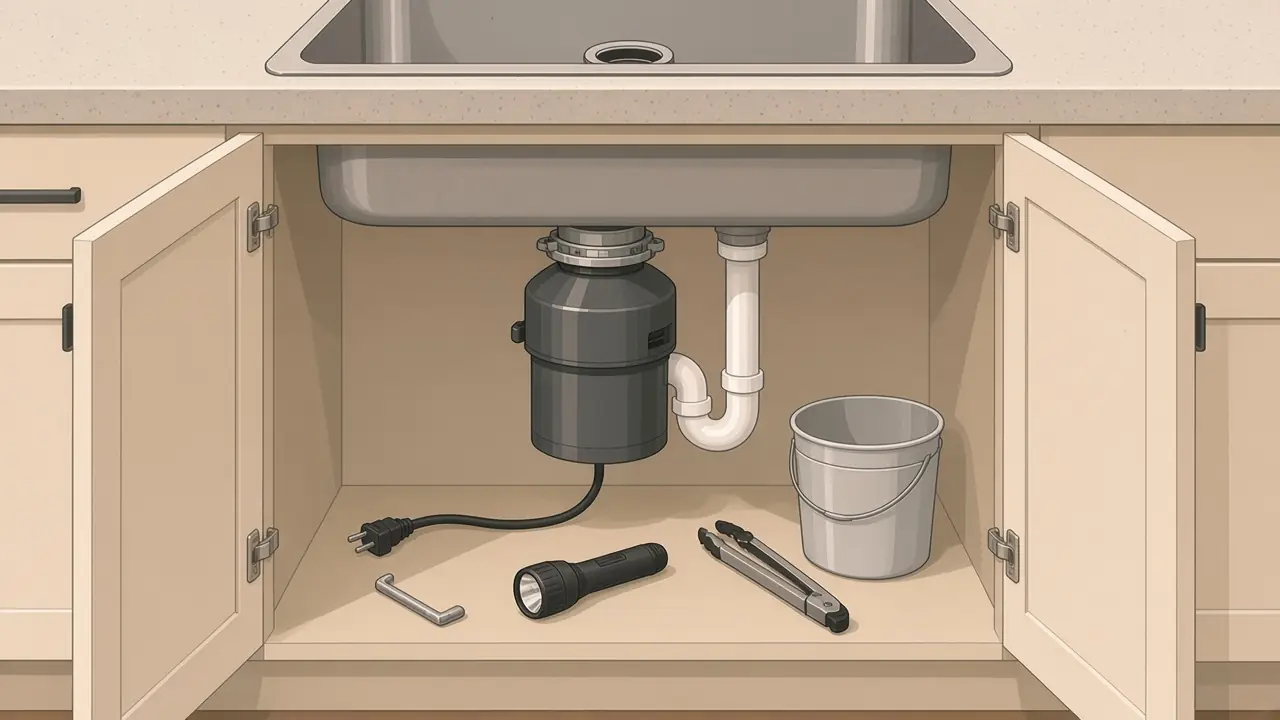
Most garbage disposal problems come down to four things: a jam (it hums but won’t spin), a tripped reset button (it’s silent), a clog in the drain past the unit (it runs but the sink won’t empty), or a leak at one of its connections. You can usually fix the first three yourself with the hex wrench that came with the disposal, tongs and a plunger. Work out which one you have, then follow that section.
Safety first, every time: turn the disposal’s wall switch off, then unplug it under the sink. If it’s hard-wired with no plug, switch off its circuit breaker. Never put your hand in the disposal, even when it’s off. InSinkErator says the same. Use tongs or pliers and a flashlight. If anyone has poured chemical drain cleaner into the sink, don’t plunge or open pipes; see “When to call a pro” below.
Work out what’s wrong
| What you notice | Likely cause | Go to |
|---|---|---|
| Hums or buzzes but doesn’t grind | Jam | Free a jam |
| Completely silent when switched on | Reset button tripped, or no power | Press the reset button |
| Runs, but water sits in the sink | Clog in the drain line | Clear a clog |
| Water under the sink | Leak at a seal or connection | Find a leak |
| Grinds, rattles or clanks | Something hard inside | Free a jam (remove the object) |
Free a jam
You need the self-service wrench that came with the disposal (InSinkErator describes it as a silver, four-inch crank) or a standard 1/4-inch Allen wrench.
- Switch off and unplug the disposal. If the sink is full, let it drain or bail it out.
- Find the hex-shaped hole dead center on the bottom of the unit, facing the floor.
- Insert the wrench and work it back and forth like a crank. InSinkErator says some force is fine because the wrench is designed to bend before the disposal is damaged.
- Keep going until it turns freely in full circles in both directions, then take the wrench out.
- Shine a flashlight into the sink opening. Look around the outer edge of the spinning plate, where the small teeth are. Lift out anything you see with tongs or pliers.
- Let the motor cool (InSinkErator’s wrench card says 3 to 5 minutes), press the red reset button, plug back in, turn on cold water, then the disposal.
If it jams again, repeat. InSinkErator notes you may need several rounds.
Press the reset button
A disposal that’s completely silent has often tripped its overload protector, which shuts the motor off after a jam or a long run.
- Switch it off.
- Find the small red button on the bottom of the unit. If it’s tripped, it sits about a quarter inch (5 mm) lower than normal.
- Press it gently. If it won’t stay in, wait about ten minutes for the motor to cool and try again.
- Some newer InSinkErator models (EZ Connect) have no button and reset themselves. Switch off and wait up to 20 minutes.
Still silent? Check that it’s plugged in, then check the circuit breaker or fuse box for a tripped breaker and reset it once. If the breaker trips again, the switch doesn’t work, or you see scorch marks, smell burning or find loose wires, stop and call an electrician. Don’t open the wiring cover or work on the switch yourself.
Clear a clog (it runs but won’t drain)
InSinkErator’s test: run the disposal and look at the water. If you see a whirlpool but the water doesn’t go down, the clog is in the drain line, not the disposal.
- Switch off and unplug the disposal.
- With a double sink, put the stopper in the other bowl so the plunger’s pressure isn’t lost.
- Fill the sink with about 4 inches of water so the plunger is covered.
- Put a cup plunger over the disposal opening, press down gently, then pull up quickly. Repeat several times.
- When it drains, plug back in and run water and the disposal for a minute or two.
If plunging doesn’t clear it, put a bucket under the P-trap (the U-shaped pipe), unscrew its slip nuts by hand, and empty and clean it. Our how to unclog a drain guide covers the trap and a hand auger step by step. Feed the auger into the drain pipe in the wall, not up into the disposal.
Find a leak
Dry everything under the sink, lay paper towels on the cabinet floor, then fill the sink and let it drain with the disposal running. The wet spot shows where the leak is. InSinkErator lists these places to check:
- Top, where it meets the sink (mounting assembly): the sink flange or mounting ring may be loose or its putty or gasket failed. Tighten the mounting ring or reseat the flange.
- Side outlet (discharge): tighten the bolts or clamp, or replace the gasket.
- Dishwasher inlet: tighten the hose clamp on the dishwasher hose.
- Nearby pipes: hand-tighten the slip nuts on the trap and tailpiece.
- Bottom or through the body of the unit: InSinkErator says to make sure it isn’t just water running down from above. If the unit itself is leaking, the seals inside have failed and the disposal usually needs replacing. Contact the maker if it’s under warranty.
Keep it working
- Run a moderate flow of cold water while grinding and for a few seconds after (InSinkErator).
- Never pour grease or fat down the disposal or any drain.
- Don’t put in things that jam or clog: bones, fruit pits, shells, coffee grounds in quantity, fibrous peels, pasta or rice in bulk, or anything that isn’t food.
- For smells, InSinkErator suggests cleaning the underside of the rubber baffle and the inside lip with a scrub pad (power off), then filling the sink halfway with warm water and 1/4 cup of baking soda and running the disposal as it drains.
When to call a pro
- Anything electrical: the breaker keeps tripping, the switch doesn’t work, the cord or plug is damaged, or the unit is hard-wired and won’t power on. Call a licensed electrician. We don’t cover disposal wiring.
- The unit hums and won’t free up with the wrench, or keeps jamming with nothing inside.
- It’s leaking from the body or the bottom, or it’s rusted through.
- Chemical drain cleaner is already in the sink. Tell the plumber which product it was.
- More than one drain backs up at once, which can mean a main line clog.
For other plumbing fixes see how to fix a leaky faucet, how to unclog a drain, how to fix a clogged toilet and how to fix a running toilet, or browse the plumbing section.
Sources
- InSinkErator, Fixing a jammed garbage disposal: switch off, never put your hand in, self-service wrench or 1/4-inch Allen wrench, turn until free in both directions, tongs and flashlight, cold water, no grease.
- InSinkErator, Resetting a garbage disposal: red overload button on the bottom, about 1/4 inch lower when tripped, wait ten minutes, EZ Connect automatic reset up to 20 minutes.
- InSinkErator, Fixing a clogged garbage disposal: whirlpool test, plunging with 4 inches of water and the other bowl stopped, baffle cleaning and baking soda.
- InSinkErator, Garbage disposal leaking: leak locations (mounting assembly, discharge, dishwasher inlet, body, motor joint, adjacent plumbing) and how to find hard-to-find leaks.
- InSinkErator, self-service wrench card (PDF): one full revolution, tongs, let the motor cool 3 to 5 minutes before pressing reset.
- Consumer Reports, How to choose and use a drain cleaner: try a plunger and snake first, never mix drain cleaners or use them with bleach.
Questions worth answering
Why does my garbage disposal hum but not spin?
Humming usually means the motor is getting power but the turntable is jammed by something hard, such as a bone, fruit pit or utensil. Switch it off and unplug it, then turn the hex socket on the bottom of the unit with the wrench that came with it, or a 1/4-inch Allen wrench, until it turns freely both ways. InSinkErator says to keep working it until it turns full circles in both directions.
Where is the reset button on a garbage disposal?
On most units it's a small red button on the bottom of the disposal, facing the floor. InSinkErator says a tripped button sits about a quarter inch (5 mm) lower than normal. Press it gently; if it won't stay in, wait about ten minutes for the motor to cool and try again.
Can I put my hand in the garbage disposal?
No. InSinkErator's instructions say never to put your hand in the disposal at any time, even with it switched off. Use tongs or pliers and a flashlight to remove objects.
Why won't my garbage disposal drain?
If the disposal runs and you can see the water swirl but it doesn't go down, InSinkErator says the clog is likely in the drain line past the disposal. Plunge the disposal opening with the other bowl stopped, then run water and the disposal for a minute or two.
Should I use drain cleaner in a garbage disposal?
We don't recommend it. Chemical drain cleaners can splash back when you plunge or open the trap, and Consumer Reports advises trying a plunger or snake first. Never mix drain cleaners with each other or with bleach.