
Cinder block calculator
Enter the wall's length and height and any openings to get the number of standard 8 × 8 × 16 in concrete blocks, with a waste allowance. Optionally, add mortar bags and the grout needed to fill the cores. The defaults are a 25 ft wall, 4 ft high, with NCMA's 5% waste.
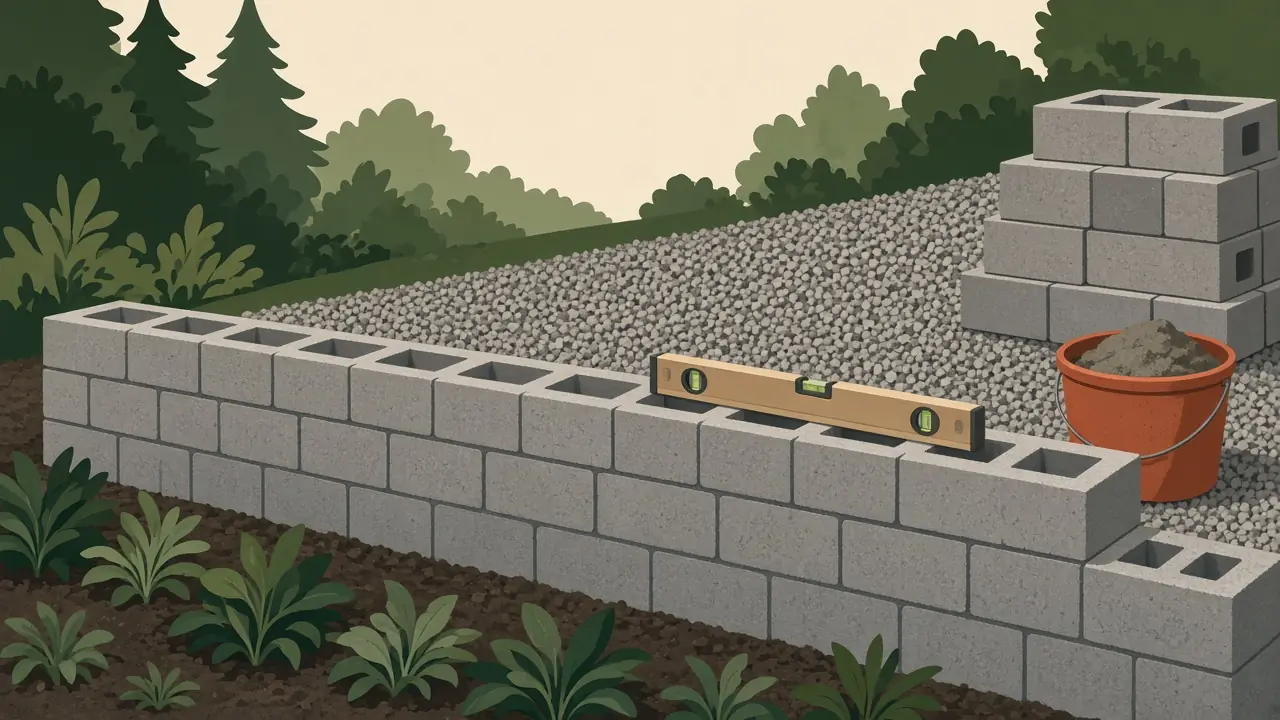
How the calculator works
- Wall area: length × height, minus openings.
- Blocks: a standard block is 7⅝ × 7⅝ × 15⅝ in; with ⅜ in mortar joints it takes up 8 × 16 in of wall face, which is 8/9 ft². So a wall needs 1.125 blocks per ft² (112.5 per 100 ft²), plus waste, rounded up. With 5% waste that's NCMA's figure of 119 blocks per 100 ft².
- Mortar: blocks ÷ 13, rounded up. Quikrete's data sheets for its Mortar Mix and Mason Mix say each 80 lb bag "will lay up to" 13 standard 8 × 8 × 16 blocks.
- Core-fill grout volume: from NCMA's Table 3 for an 8 in wall, in ft³ per 100 ft² of wall: 36.1 for every core, 18.1 at 16 in spacing, 12.1 at 24 in, 9.1 at 32 in, 7.3 at 40 in and 6.1 at 48 in. These include 3% waste.
- Grout bags: the number of cores to fill (two per block, every core or every few) ÷ 2.7, NCMA's yield for an 80 lb bag of preblended grout in 8 in block.
Worked example
A garden wall 25 ft long and 4 ft high, no openings, 5% waste, with mortar, grouted every 48 in:
- Area: 25 × 4 = 100 ft². Blocks: 100 × 1.125 × 1.05 = 118.1, so 119 blocks in 6 courses.
- Mortar: 119 ÷ 13 = 9.2, so 10 bags of 80 lb at the very least.
- Grout: 100 ft² × 6.1 ÷ 100 = 6.1 ft³. Cores: 112.5 blocks × 2 × 8⁄48 = 37.5, ÷ 2.7 = 13.9, so 14 bags.
Assumptions and limits
- Standard 8 in hollow blocks only, laid in running bond with ⅜ in joints. Half blocks, corner and bond-beam units still count by area, but pilasters and columns need separate counts.
- The two grout figures don't agree exactly. NCMA's volume table works out to about 0.16 ft³ per core, but its bag-yield table works out to about 0.24 ft³ per core (2.7 cores from a 0.66 ft³ bag). The bag count uses the bag-yield table, so it's the more generous of the two. Units with large cores, spillage and blocks that soak up water all use more.
- Grout, not concrete, is the material for filling block cores. Grout is a fluid mix made to flow around steel bars; use a product labeled for core fill, or the mix your plans specify.
- Mortar varies. Joint thickness, full versus face-shell bedding and waste all change the count. Quikrete's figure is an upper bound on blocks per bag, so you may need more bags, not fewer.
- The footing isn't included. Work out its concrete with the concrete calculator (footing mode).
Call 811 at least a few days before you dig a footing so buried utility lines can be marked. Under the International Residential Code, retaining walls over 4 ft (measured from the bottom of the footing), or any wall holding back a driveway, slope or structure, need a permit, and walls retaining more than 4 ft of soil must be engineered; local rules can be stricter. Blocks are heavy: get help, lift with your legs, and wear gloves and eye protection. Cutting block makes silica dust, so use a wet saw or a saw with a dust collector and wear a respirator.
Sources
- NCMA (now CMHA), TEK 4-2A, Estimating concrete masonry materials: 8/9 ft² per unit, 119 units per 100 ft² with 5% waste, grout volumes (Table 3) and bagged grout yields (Table 4).
- Quikrete, Mortar Mix data sheet and Mason Mix data sheet (PDFs): an 80 lb bag lays up to 13 standard blocks.
- International Code Council, 2021 IRC section R105.2 (permit exemptions) and section R404.4 (retaining walls).
- OSHA, Crystalline silica.
- Call811.com.