
Mulch calculator
Enter the size of the bed and how deep you want the mulch to get cubic yards for a bulk delivery, or the number of 2 or 3 cubic foot bags. The defaults are a 20 × 4 ft bed, 3 inches deep.
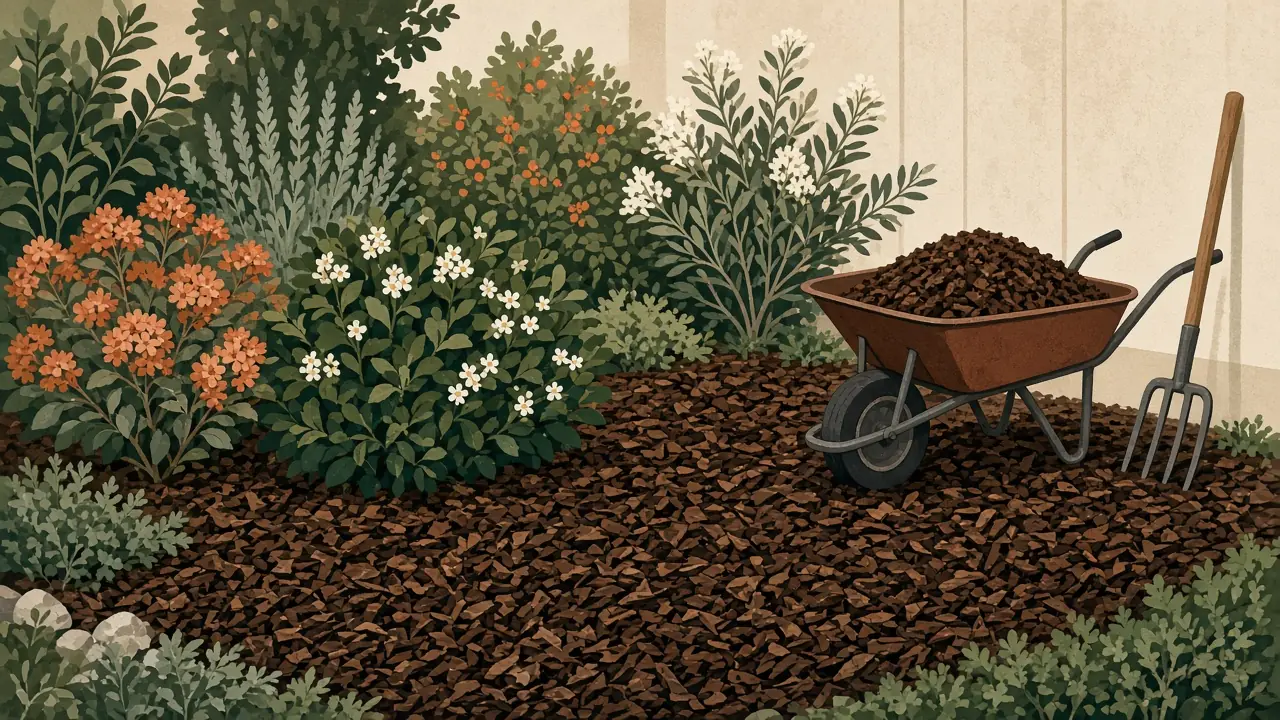
How the calculator works
- Area of the bed in square feet. For a ring around a tree, it's the area of the ring minus the bare circle you leave around the trunk. For an odd-shaped bed, split it into rectangles and triangles, or total the area first with the square footage calculator. For plain volume (any material), use the cubic yard calculator.
- Volume: area × depth in inches ÷ 12 = cubic feet; ÷ 27 = cubic yards. A shortcut that gives the same answer: area × depth in inches ÷ 324.
- Bags: cubic feet ÷ 2 or ÷ 3, rounded up. A cubic yard is 13.5 two-cubic-foot bags or 9 three-cubic-foot bags.
Worked example
A 20 × 4 ft bed along a fence, 3 in deep:
- Area: 20 × 4 = 80 ft²
- Volume: 80 × 3 ÷ 12 = 20 ft³, which is 0.74 yd³
- Plus 5%: 21 ft³ = 0.78 yd³
- Bags: 21 ÷ 2 = 10.5, so 11 bags of 2 cu ft, or 21 ÷ 3 = 7 bags of 3 cu ft
What one cubic yard covers
| Depth | 1 cubic yard covers | One 2 cu ft bag covers |
|---|---|---|
| 1 in | 324 ft² | 24 ft² |
| 2 in | 162 ft² | 12 ft² |
| 3 in | 108 ft² | 8 ft² |
| 4 in | 81 ft² | 6 ft² |
How deep to spread it
- Most beds and tree rings: 2–3 in. That's the depth Penn State Extension and University of Illinois Extension recommend. Fresh mulch looks deeper at first and settles.
- Coarse wood chips can go a little deeper. The International Society of Arboriculture (ISA) suggests 2–3 in for fine mulches and 3–4 in for coarse arborist chips on well-drained sites, and less on wet, poorly drained soil.
- Topping up an old bed: measure what's already there first. Illinois Extension notes that people often top-dress every year without checking the depth, and deep mulch can keep roots too wet. If you already have 2 in, you may only need about 1 in, so enter that depth.
- Never pile it against the trunk. “Mulch volcanoes” hold moisture against the bark and can lead to decay and girdling roots. Leave the root flare visible.
Assumptions
- Bags are sold by volume. Check yours: 2 cu ft and 3 cu ft are common, but not universal.
- Bulk mulch is sold by the cubic yard, and many suppliers have a minimum delivery. Rounding up to the next half or whole yard is normal.
- The calculator doesn't estimate weight, because it varies too much with the material and how wet it is.
Related: laying a gravel path or stone mulch instead? Use the gravel calculator, which works in tons too. Filling a bed with soil before you mulch? Use the topsoil calculator. Seeding a lawn after grading? Use the grass seed calculator.
Wear gloves; bark and wood chips splinter. Lift bags with your legs, and use a wheelbarrow for more than a few. Keep mulch a few inches back from the house's siding and wood framing, and don't bury dryer vents or utility meters. If you're planting or edging deeper than a few inches, call 811 first.
Sources
- Penn State Extension, Mulch volcanoes are erupting everywhere!
- University of Illinois Extension, Too much of a good thing: mulch volcanoes slowly kill trees.
- International Society of Arboriculture (TreesAreGood.org), Proper mulching techniques (PDF).
- Coverage per cubic yard is plain arithmetic (27 ft³ × 12 ÷ depth in inches); the table matches figures published by mulch suppliers.