
Sewer line replacement cost
Sewer line replacement costs $50 to $250 per linear foot, or about $2,000 to $10,000 for a typical 40-foot run, according to HomeGuide. Angi's October 2026 data puts the average project at $3,319 (most pay $1,388–$5,323)—that figure includes many shorter and partial jobs. Below are the published ranges by method and length, the extras that push a quote up, and an estimator you can fill in with numbers from your own quotes.
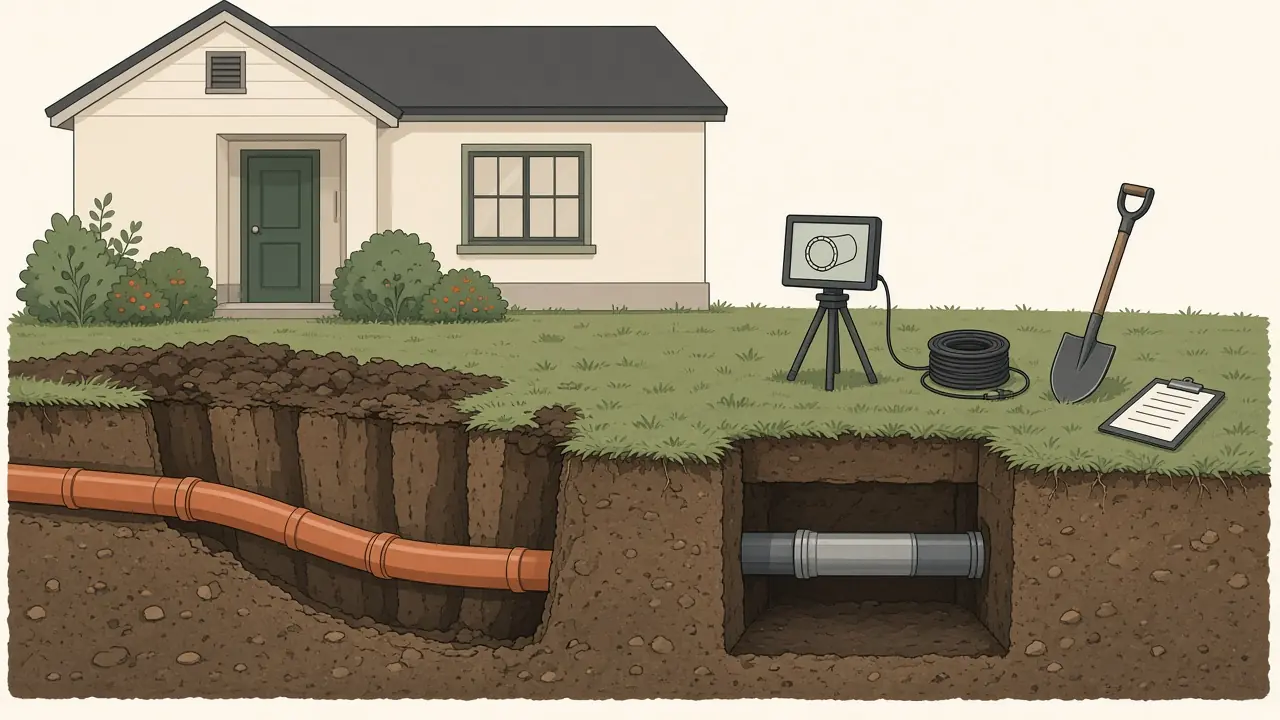
Published cost ranges
These are US national ranges as each source publishes them. None of them are our own prices.
| Source (date) | Per linear foot | Typical total | Average |
|---|---|---|---|
| HomeGuide (Dec 22, 2025) | $50–$250 | $2,000–$10,000 (40 LF) | $6,000 |
| Angi (updated Oct 29, 2026) | $50–$250 (avg ~$150); complete $60–$250 | $1,388–$5,323 | $3,319 (1,037 projects) |
| Fixr (Jan 31, 2025) | Dig $50–$250; bursting $50–$200; CIPP $80–$250 | Often $1,000–$20,000 depending on access | – |
The averages conflict. HomeGuide's $6,000 average for a typical ~40-foot replacement sits well above Angi's $3,319 project average. Angi's sample includes shorter and partial replacements (it even lists "partial" at about $50/LF), so the two averages are not measuring the same job. We print both and let the per-foot math drive the estimator.
By length
| Length | HomeGuide total |
|---|---|
| 10 linear ft | $500–$2,500 |
| 20 linear ft | $1,000–$5,000 |
| 40 linear ft | $2,000–$10,000 |
| 60 linear ft | $3,000–$15,000 |
| 80 linear ft | $4,000–$20,000 |
HomeGuide notes most full residential replacements are around 40 feet; partial repairs often cover only 1 to 15 feet.
By method
| Method | HomeGuide | Angi | Fixr |
|---|---|---|---|
| Traditional dig and replace | $50–$250 (headline all replacement) | Complete $60–$250 | $50–$250 |
| Pipe bursting (trenchless) | $60–$200 | $60–$200 | $50–$200 (text); table also shows $50–$250 |
| CIPP lining (trenchless) | $90–$250 | $90–$250 | $80–$250 |
| Spin-casting / internal coating | $80–$250 | – | Internal coating $50–$250; pull-in-place $60–$200 |
Angi notes trenchless is a poor fit when the pipe has collapsed or has the wrong slope—those jobs still need excavation. HomeGuide prices traditional trenching itself at $5–$12/LF and trenchless boring at $10–$30/LF on top of pipe work when quoted separately.
Extras that change the quote
- Camera inspection: $125–$500 (HomeGuide), $100–$500 (Angi), $200–$400 (Fixr).
- Permits: $30–$500 (HomeGuide); Fixr cites about $75 as a typical plumbing permit.
- Cleanout: $500–$2,000 to add one (HomeGuide).
- Backflow preventer: $150–$1,200 (HomeGuide).
- Landscaping restoration: Angi $4.50–$12 per sq ft; yard leveling $1–$2 per sq ft.
- Driveway / hardscape: Angi concrete driveway repair $1–$25 per sq ft, asphalt $1–$15. HomeGuide adds $3–$8 per sq ft for concrete removal over the line.
- Under a slab or basement: access gets expensive—Fixr puts under-slab drain repairs at $500–$4,500 and under-house work at $600–$5,000; Angi notes sections under concrete can reach $300–$350 per linear foot.
Settling soil and water around a failing lateral can also show up as foundation problems—see our foundation repair cost guide if you have new cracks or sloping floors along with sewer issues.
Estimate your own job
The main line multiplies HomeGuide's per-foot range for the method you choose by the length in feet. Camera, permit, cleanout and backflow use HomeGuide figures; landscaping and driveway restoration use Angi's per-square-foot ranges. Type a figure from your own quote and that line uses your number instead.
Repair vs replace
HomeGuide puts typical repairs at $150–$3,800 (snaking $150–$500, hydro jetting $250–$800, or a short trenchless section). Angi lists spot crack repairs at $600–$1,050 and root removal at $100–$600. Replacement makes more sense for collapsed pipe, widespread damage, or outdated Orangeburg/clay laterals that keep failing.
DIY or hire a pro?
Open-trench and trenchless sewer work needs licensed plumbers, locating equipment, and often a permit. Fixr and HomeGuide both treat this as a professional job. Homeowners can clear minor fixture clogs (see our plumbing guides) but should not dig a lateral or attempt lining without the right gear and approvals.
- Call 811 before any digging so utilities can mark gas, electric and other lines.
- Sewage exposure needs gloves, eye protection and proper disposal—don't treat a lateral break like a sink clog.
- Trench walls can collapse; follow OSHA excavation rules and keep people out of unprotected trenches.
Getting quotes
- Start with a camera inspection and a written diagnosis of length, material and method.
- Get at least three itemized estimates that say whether restoration (lawn, driveway, sidewalk) is included.
- Verify license, insurance and warranty; HomeGuide advises against paying in full up front.
Related: foundation repair cost, how to unclog a drain, how to fix a clogged toilet, how to fix a garbage disposal, plumbing guides and the cost guides.
FAQ
How much does sewer line replacement cost?
HomeGuide (December 22, 2025) puts replacement at $50 to $250 per linear foot, or $2,000 to $10,000 for a typical 40-foot run, with a $6,000 national average. Angi (updated October 29, 2026) reports a $3,319 average from 1,037 projects, with most homeowners paying $1,388 to $5,323—that average folds in shorter and partial jobs. Fixr (January 31, 2025) cites dig-and-replace and trenchless methods at about $50 to $250 per foot.
How much does trenchless sewer repair cost vs digging?
HomeGuide lists pipe bursting at $60–$200 per linear foot and CIPP lining at $90–$250. Angi puts complete dig-and-replace at $60–$250, pipe bursting at $60–$200 and CIPP at $90–$250. Fixr's dig-and-replace and pipe-bursting ranges sit at $50–$250 / $50–$200, with CIPP at $80–$250. Trenchless usually means less yard damage, but collapsed or badly misaligned pipes still need a traditional dig.
How much does a sewer camera inspection cost?
HomeGuide says $125 to $500. Angi says $100 to $500. Fixr's drain-line page puts video inspection at $200 to $400.
Who pays for the sewer line—homeowner or city?
HomeGuide and Angi both say the homeowner usually owns the lateral from the house to the city main; the municipality owns the main in the street. Condo or townhome HOAs sometimes cover shared lines—check your documents.
Does homeowners insurance cover sewer line replacement?
Most standard policies exclude wear-and-tear and root intrusion. HomeGuide and Angi note that sudden covered events may be different, and some insurers sell sewer-line endorsements. Read your own policy.
How long does sewer line replacement take?
HomeGuide says about 1 to 5 days, with trenchless usually faster than open trench work.
Sources
All checked November 9, 2026. Dates are each page's own published or updated date.
- HomeGuide, How much does sewer line replacement cost?, December 22, 2025: $/LF, length table, pipe bursting, CIPP, camera, permits, cleanout, backflow, materials.
- Angi, How much does sewer line replacement cost?, updated October 29, 2026: average and range, complete vs partial vs CIPP vs bursting, camera, landscaping and driveway restoration.
- Fixr, Cost to repair a drain line breakage, updated January 31, 2025: dig-and-replace, pipe bursting, CIPP, camera; also Fixr unclog main sewer line and sewer line cleaning for replacement $/LF context.