
Landscaping & yard
How to lay mulch
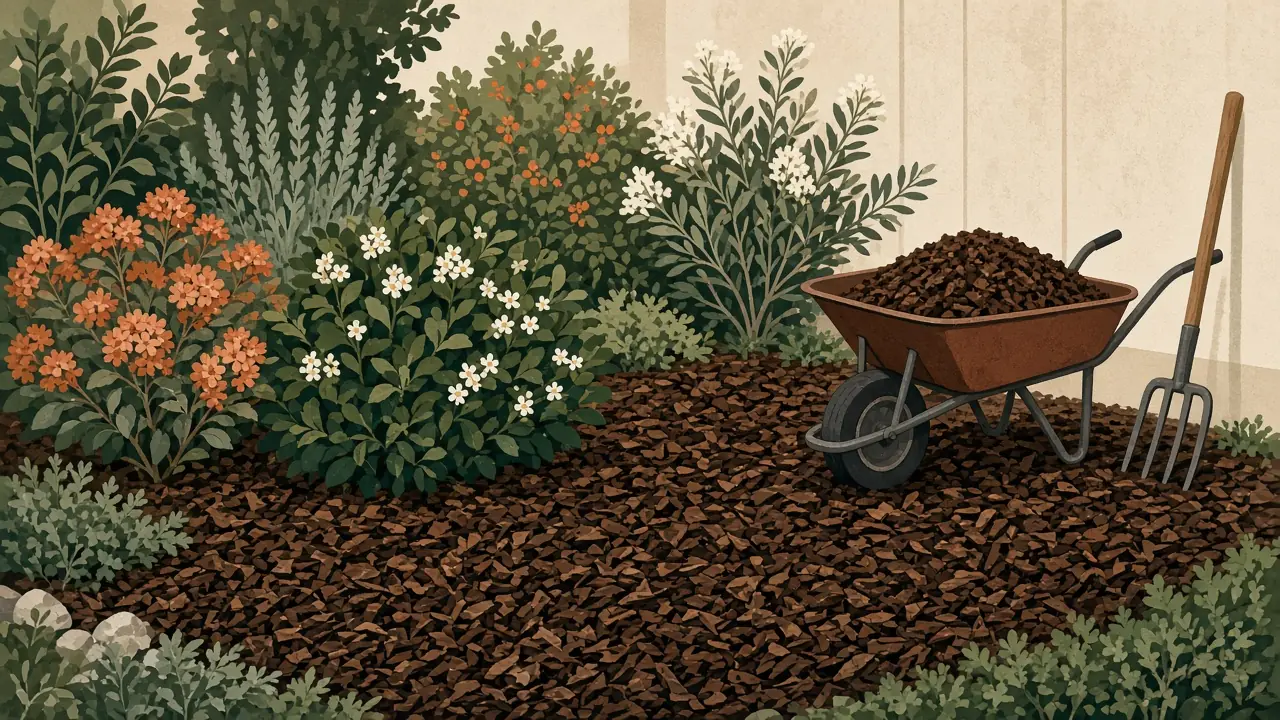
Mulch is one of the easiest garden jobs to do well, and one of the easiest to overdo. A few inches, spread evenly and kept off the trunks and stems, holds moisture in, keeps weeds down and protects tree trunks from mowers and string trimmers. Piling it deeper doesn’t make it work better; it can hurt the plants.
Before you start: wear gloves, since bark and wood chips splinter. Lift bags with your legs and move them with a wheelbarrow. If you’re edging or planting deeper than a few inches, call 811 first. Keep mulch a few inches back from siding and wood framing, and don’t cover dryer vents, meters or window wells.
1. Work out how much you need
Measure each bed’s length and width, or its diameter for a round tree ring, and decide on a depth. The mulch calculator turns that into cubic yards for a bulk delivery or into 2 and 3 cubic foot bags. It has a tree-ring shape that leaves a bare circle around the trunk.
As a quick check: one cubic yard covers about 108 ft² at 3 in deep, and a 2 cu ft bag covers about 8 ft². Building a new bed? Work out the soil underneath with the topsoil calculator. For a stone or gravel path beside it, use the gravel calculator.
2. Choose the material
Organic mulches include shredded bark, wood chips, pine needles, leaves and compost blends. They break down over time and add organic matter to the soil, so they need topping up. Illinois Extension notes that some, such as cypress, last for years but fade to gray. Coarse arborist wood chips are a good choice around trees, according to the International Society of Arboriculture (ISA).
3. Prepare the bed
- Pull weeds, roots and all, so you start with a clean bed. Mulch helps keep new weeds down; it is not a substitute for weeding.
- Cut a clean edge between the bed and the lawn with a flat spade or edger so the mulch stays put.
- If the soil is dry, water the bed first. Mulch helps conserve soil moisture, so it works best over soil that has some.
4. Spread it evenly, 2–3 inches deep
- Dump small piles around the bed rather than one big heap, then spread them with a garden fork or rake.
- Aim for 2–3 in. That’s the depth Penn State Extension and University of Illinois Extension recommend. Check with a ruler in a few spots; fresh mulch looks deeper than it is and settles.
- For coarse wood chips on well-drained ground, ISA allows 3–4 in. On wet, poorly drained soil, go thinner.
- Pull mulch back from the base of shrubs and perennials so the stems stay dry.
5. Mulch trees as a ring, not a volcano
- Leave the root flare, where the trunk widens into roots, visible and dry. Keep mulch a few inches off the bark.
- Make the ring wide rather than deep. ISA suggests extending it toward the drip line where you can, with a 3 ft radius as a practical minimum for most trees.
- Avoid “mulch volcanoes”, the cones piled against trunks. Penn State and Illinois Extension both explain the damage: wet mulch against bark leads to decay and insect and disease problems, and roots growing up into deep mulch can circle and girdle the trunk.
6. Refresh old mulch instead of piling on more
Each spring it’s tempting to add another full layer. Measure first:
- Rake the old mulch to break up matted or crusted layers. ISA notes that this alone often refreshes its appearance.
- If it’s still 2–3 in deep, add only a thin skim layer of fresh mulch, as Penn State Extension recommends.
- If it’s thinner, top up to the target depth. In the calculator, enter just the depth you’re adding.
The Morton Arboretum’s advice is to check mulch depth every year and replenish as necessary.
Sources
- Penn State Extension, Mulch volcanoes are erupting everywhere!
- University of Illinois Extension, Too much of a good thing: mulch volcanoes slowly kill trees.
- International Society of Arboriculture (TreesAreGood.org), Proper mulching techniques (PDF).
- The Morton Arboretum, How to mulch trees and shrubs.
- Common Ground Alliance, Call 811.
Questions worth answering
How deep should mulch be?
Penn State and Illinois Extension recommend 2–3 in for most beds and trees. The International Society of Arboriculture allows 3–4 in for coarse wood chips on well-drained ground, and less on wet sites.
Should I remove old mulch before adding new?
Not usually. Check how deep it is first. If there's already 2–3 in, break up any matted layer with a rake and add only a thin skim of fresh mulch, as Penn State Extension suggests, rather than another full layer.
How much does one bag of mulch cover?
A 2 cubic foot bag covers about 8 ft² at 3 in deep, or 12 ft² at 2 in. A 3 cubic foot bag covers about 12 ft² at 3 in.