
Landscaping & yard
How to install a gravel driveway
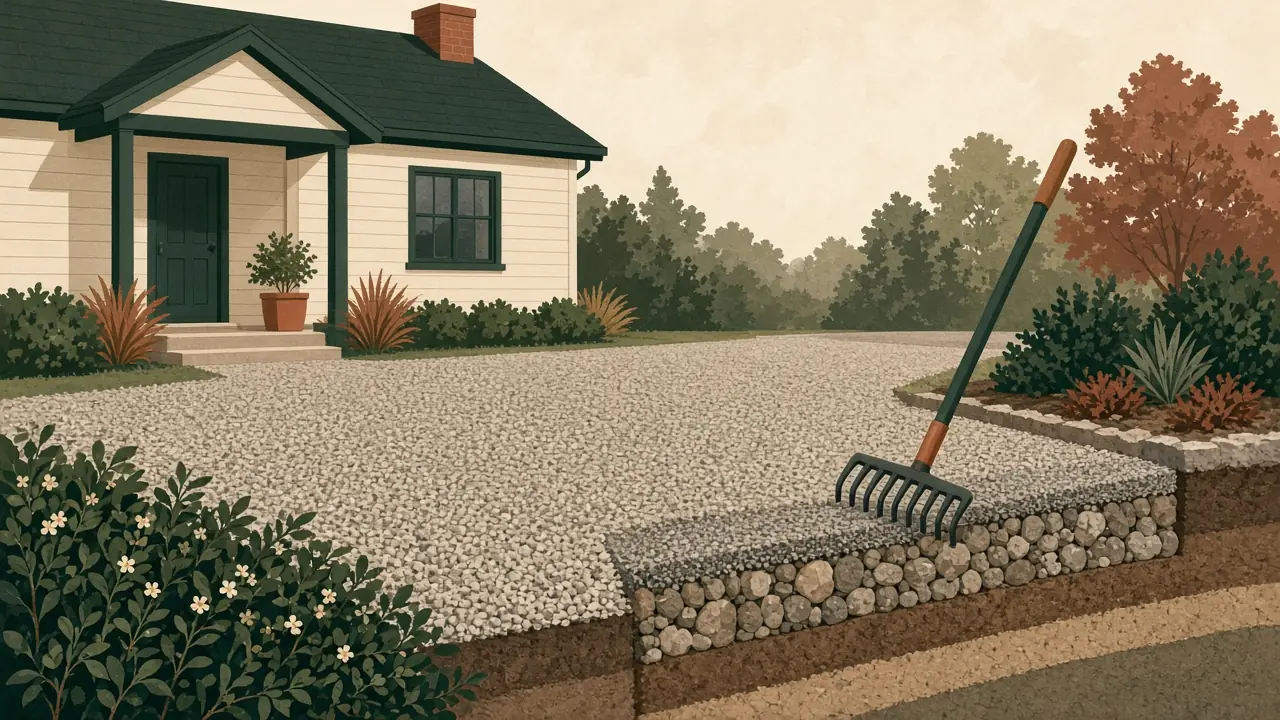
A gravel driveway fails in one of two ways: water sits on it, or the stone sinks into soft soil. Good stone matters less than shape, drainage and a firm base. This guide covers a typical residential driveway or parking pad. For long rural drives, steep grades or anything that connects to a public road, check local permit and entrance rules first. Many towns regulate curb cuts and culverts.
Before you dig: call 811. Utility lines often run under driveways. Keep delivery trucks off septic tanks and drain fields. Rent a plate compactor rather than tamping a whole driveway by hand, and read the rental shop’s safety sheet.
1. Plan the size and the water
- Width: measure your widest vehicle and add room to open doors and walk alongside. Many towns set minimum or maximum widths and rules for where a driveway meets the street, so check before you dig.
- Where water goes: decide which way rain runs off before you dig. A gravel road has three parts: a crowned surface, a shoulder that slopes away, and a ditch or swale. A driveway needs the same.
2. Strip and shape the subgrade
- Remove sod and topsoil until you reach firm mineral soil. Organic soil compresses and stays soft.
- Shape the subgrade with the same crown or cross-slope as the finished surface. Water that gets through the stone should drain off the subgrade too.
- Compact the subgrade. Dig out any soft, wet spots that pump under a boot and fill them with stone.
- On soft, silty or clay soil, lay a road-grade geotextile with generous overlaps. FHWA’s gravel road guide describes it as a separator that stops fine soil migrating up into new stone.
3. Build it in layers
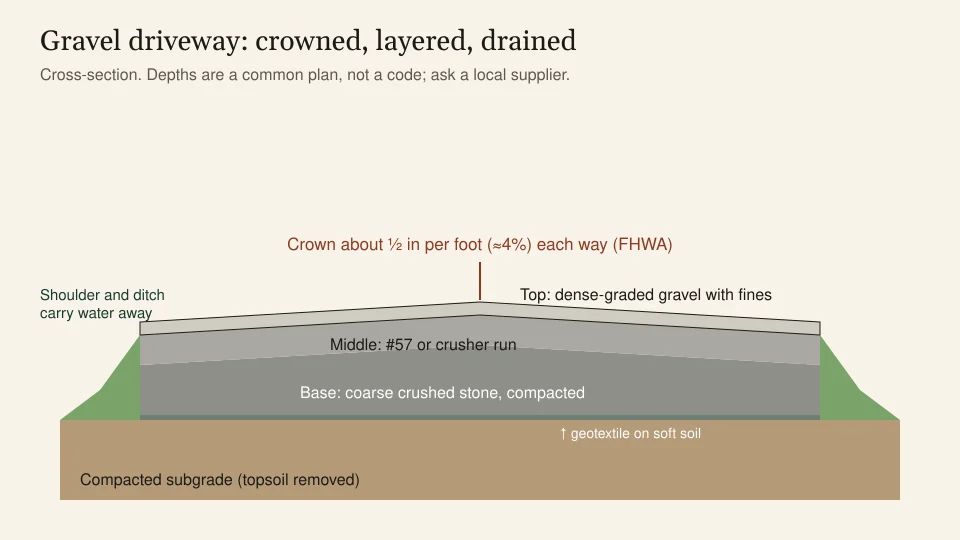
A common residential plan, not a code requirement:
| Layer | What | Why |
|---|---|---|
| Base | Coarse angular crushed stone, a few inches deep | Spreads the load over soft soil and drains |
| Middle | #57 stone or crusher run | Fills the gaps and locks the base |
| Top | Dense-graded gravel with fines (crusher run, “driveway mix”) | Fines bind into a firm, shed-water surface |
Spread and compact each layer in lifts of a few inches. One thick lift won’t compact all the way through. Ask your supplier what they recommend for your soil. They know which local stone packs well.
Run the gravel calculator once per layer. Dense-graded stone weighs about 1.5 tons per cubic yard (one supplier’s published figure), and it compacts, so ask whether your supplier quotes loose or compacted depth.
4. Crown the surface
FHWA’s Gravel Roads guide says a crown of about ½ in per foot (roughly 4%) from the center to each edge is what experienced operators recommend, and warns against going over 6%. On a 12 ft driveway, that’s about 3 in higher at the centerline than at each edge. Driveways along a slope can use a single cross-slope toward the downhill side instead of a crown.
5. Maintain it
- Rake or drag the surface to refill ruts and potholes before water ponds in them.
- Top up with surface gravel as it thins. The calculator’s depth field handles a 1–2 in top-up.
- Keep ditches and culverts clear.
Sources
- FHWA, Gravel Roads Construction & Maintenance Guide (cross-section elements; ½ in per ft crown, not over 6%; geotextile as separator).
- American Rock Supply, Gravel calculator (crusher run ≈1.50 tons/yd³).
- Common Ground Alliance, Call 811.
Questions worth answering
Do I need landscape fabric under a gravel driveway?
Use a geotextile made for driveways or roads, not thin weed-barrier fabric, where the soil is soft, silty or clay. FHWA describes it as a separator that stops fine soil from pumping up into the stone. On firm, free-draining ground it's often skipped.
Can I use pea gravel for a driveway?
Round stone like pea gravel rolls under tires and doesn't lock together, so it ruts. Angular crushed stone, with fines in the top layer, packs into a firmer surface.
How much does a gravel driveway cost?
It depends almost entirely on local stone and delivery prices, so this site doesn't quote one. Get the tonnage from the gravel calculator, then ask two or three local quarries or landscape yards for a delivered price per ton.