
Well drilling cost
A complete 200-foot residential well costs $6,000 to $16,000 on average, or $30 to $80+ per foot installed, according to HomeGuide, with a national average of $10,500. Angi puts most jobs at $3,000 to $9,000, averaging $5,500. Below are the published ranges by depth, well type and region, the extras that change a quote, and an estimator you can fill in with numbers from your own bids.
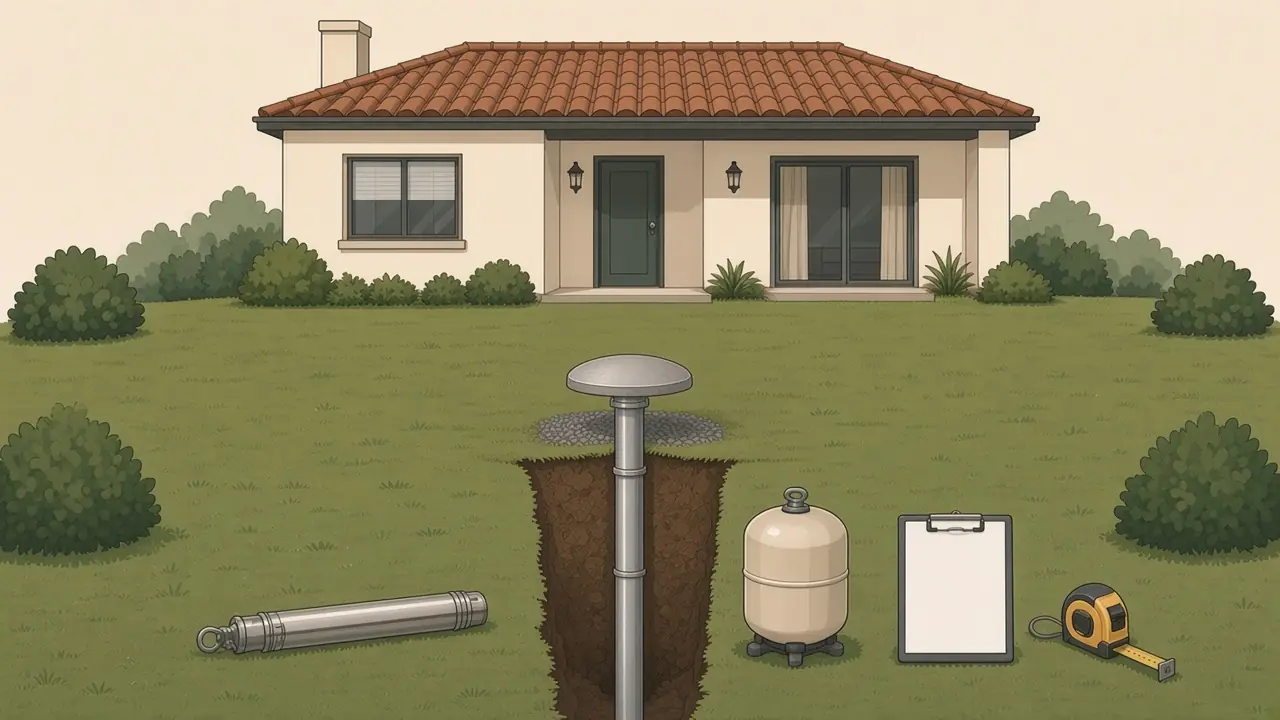
Published cost ranges
These are US national ranges as each source publishes them. None of them are our own prices. Fixr does not publish a dedicated well-drilling cost guide, so the third dated source here is This Old House, which states that its figures are based on Angi and Culligan unless otherwise noted.
| Source (date) | Per foot | Typical total | Average |
|---|---|---|---|
| HomeGuide (Jul 30, 2025) | Complete $30–$80+; drilling only $20–$30 | $6,000–$16,000 for a 200 ft well | $10,500 |
| Angi (updated Sep 18, 2026) | $25–$65 (rocky/remote: budget $50–$75) | $3,000–$9,000 | $5,500 |
| This Old House (updated Mar 30, 2026) | $25–$65 | $3,500–$15,000 | — |
The sources don't fully agree, and they are not always pricing the same job. HomeGuide's $10,500 average is a complete 200-foot well that the intro says includes casing, the pump, electrical connections and permits. Angi's $5,500 average and $3,000–$9,000 typical range sit lower, and Angi separately tells readers to budget for a pump, tank, permit and water test. This Old House's $3,500–$15,000 range is closer to HomeGuide's span; the same page says that total includes drilling plus the casing, pump and storage tank, and that its figures come from Angi and Culligan.
Two typographical issues are worth flagging so they are not mistaken for extra data. Angi's "Cost Insights" bullet says professional well drilling costs "$3,000 and $9,000 per foot"—that is the typical project range from the same page, not a per-foot rate. This Old House's 300-foot row is written "$10,650–18,360", missing a dollar sign on the high end; the number matches Angi's 6-inch steel average.
By well depth
| Depth | HomeGuide complete | HomeGuide drilling only | Angi 4-inch PVC (avg) | Angi 6-inch steel (avg) |
|---|---|---|---|---|
| 50 ft | $1,500–$4,000+ | $1,000–$1,500 | $1,775 | $3,060 |
| 100 ft | $3,000–$8,000+ | $2,000–$3,000 | $3,550 | $6,120 |
| 150 ft | $4,500–$12,000+ | $3,000–$4,500 | $5,325 | $9,180 |
| 200 ft | $6,000–$16,000+ | $4,000–$6,000 | $7,100 | $12,240 |
| 250 ft | — | — | $8,875 | $15,300 |
| 300 ft | $9,000–$24,000+ | $6,000–$9,000 | $10,650 | $18,360 |
| 400 ft | $12,000–$32,000 | $8,000–$12,000 | $14,200 | $24,480 |
| 500 ft | $15,000–$40,000 | $10,000–$15,000 | — | — |
HomeGuide's depth columns are $30–$80/ft (complete) and $20–$30/ft (drilling only) multiplied by depth. Angi's PVC and steel columns are point averages, not ranges: $35.50/ft and $61.20/ft. This Old House prints those same two Angi figures as a low–high range for each depth (for example $7,100–$12,240 at 200 feet) and notes the Angi/Culligan sourcing. Angi also says that at an average of $30 per foot, a standard 50- to 200-foot residential well could run $1,500 to $6,000, or roughly $4,200 to $25,000 with larger 8-inch casing.
By well type
| Type | HomeGuide | Angi | This Old House |
|---|---|---|---|
| Residential | $30–$80+ (typical total $3,000–$24,000+) | $25–$65 | $25–$65 (total $3,750–$15,300) |
| Irrigation | $30–$100+ (total $3,000–$40,000+) | $25–$110 | $50–$100 (total $5,000–$75,000) |
| Artesian | $35–$90 (total $5,300–$40,500) | $35–$90 | $25–$85 (total $5,000–$15,000) |
| Geothermal | $20–$40+ (total $2,000–$20,000+) | $15–$40 | $15–$40 (total $3,500–$5,000) |
Irrigation and artesian totals diverge the most: This Old House's artesian top of $15,000 sits well below HomeGuide's $40,500, and its irrigation top of $75,000 sits above HomeGuide's $40,000+. Geothermal per-foot lows also differ ($15 vs $20). We print each figure as published. HomeGuide also lists commercial wells at $50,000–$100,000+; Angi lists high-yield commercial wells at $25–$80 per foot.
By region (Angi state averages)
Angi publishes average per-foot ranges for eight states. These are not complete-installation rates in the HomeGuide sense, and they are not split by well type.
| State | Per foot |
|---|---|
| Florida | $26–$58 |
| Colorado | $28–$62 |
| Texas | $28–$62 |
| Minnesota | $28–$65 |
| California | $30–$70 |
| New York | $30–$70 |
| Massachusetts | $31–$61 |
| Alaska | $34–$85 |
Extras that change the quote
HomeGuide's complete per-foot rate is described as including casing, the pump, electrical connections and permits, then later says a pump, pressure tank and electrical connections are not always in the per-foot quote. If a bid is "drilling only," add these lines. If it is a complete package, check the itemized quote before stacking them on top or you may double-count.
- Casing: PVC $7–$11/ft (HomeGuide) vs $6–$10/ft (Angi and This Old House). Steel $30–$130+/ft in all three sources. Residential casing is typically 4 to 8 inches in diameter.
- Well pump: $400–$2,500 (HomeGuide) vs $900–$2,500 (Angi) vs $300–$2,000 for an electric pump, or $150–$500 for a shallow-well hand pump (This Old House). Angi lists pump replacement labor at $45–$150/hour or $250–$1,000 per job.
- Pressure tank: $800–$1,500 (HomeGuide) vs $300–$500 plus installation, or about $200 for a 2-gallon tank up to $1,100 for a 44-gallon tank (Angi) vs $100 for a small tank and $1,400–$2,400 for a large one (This Old House).
- Electrical hookup: $1,000–$3,000 (HomeGuide). Angi prices supply lines at $50–$150 per foot plus $160–$500 labor. This Old House lists electrical components at $50–$150 and a licensed electrician at $150–$500, and the same $50–$150/ft for piping and electrical lines to the house. This is a cost line only; the hookup is done by a licensed electrician. This page does not include wiring instructions.
- Permit: $350–$700+ (HomeGuide) vs $200–$500 (Angi) vs $5–$500 (This Old House).
- Water testing: laboratory test $100–$350 (HomeGuide) vs a DIY kit about $100 or professional lab analysis $50–$600 (Angi) vs DIY $50–$150 or professional $100–$500 (This Old House).
- Inspection: $250–$550 (HomeGuide and Angi).
- Filtration / treatment: well filtration $800–$4,000 and a water softener $1,200–$3,800 (HomeGuide). Angi lists purification systems at $1,000–$15,000 plus $200–$400 to install. This Old House puts whole-home treatment at $500–$3,000 plus $200–$400 installation.
HomeGuide's method rates (drilling only) are $20–$30/ft to drill, $25–$40/ft to drive (up to about 50 feet in sandy soil) and $15–$30/ft to dig (about 25–50 feet). Angi instead gives starting costs at a 150-foot depth: drilled $5,500, driven $4,000, dug $2,500, and notes that driven and dug wells are only for water tables of 50 feet or less—so those starting figures should not be read as 150-foot driven or dug wells.
Estimate your own job
The main line uses HomeGuide's complete $30–$80/ft or drilling-only $20–$30/ft for a residential well, HomeGuide's per-foot rate for irrigation, artesian or geothermal wells, or Angi's state average when you pick one of the eight published states (residential only). Extras use HomeGuide's component ranges and are off by default so they are not stacked on a complete package unless you choose them. Type a figure from your own quote and that line uses your number instead.
DIY or hire a pro?
All three sources treat a full-depth residential well as a professional drilling job. A licensed well contractor has the rig, knows local aquifers, and usually handles permits. This Old House says digging or driving a shallow well can be within reach of some DIYers where the water table is high, but those wells supply limited water and still need permits and testing. Leave pump wiring to a licensed electrician.
- Call 811 before any excavation so utilities can mark buried lines.
- Follow local setbacks from septic systems, property lines and other wells. Your health department sets the rules.
- Test the water before drinking it. The US EPA's private well guidance recommends testing a private well at least annually, and after repairs or flooding, using a certified laboratory.
- Electrical hookups for the pump and pressure switch are done by a licensed electrician. This page does not include wiring instructions.
Getting quotes
- Get at least three itemized written estimates from licensed, insured well drillers who work in your area.
- Ask whether the per-foot price is drilling only or a complete system, and whether casing, the pump, the pressure tank, the electrical hookup, the permit, the yield test and a water test are included.
- Ask how they price rock, a dry hole, or extra depth if the first aquifer is insufficient.
- Confirm who pulls the permit and who hires the electrician.
Related: sewer line replacement cost, foundation repair cost, tree removal cost, fence installation cost and the cost guides.
FAQ
How much does it cost to drill a well?
HomeGuide (July 30, 2025) puts a complete 200-foot residential well at $6,000 to $16,000, averaging $10,500, or $30 to $80+ per foot including drilling, casing, pump installation, electrical connections and permits. Drilling alone is $20 to $30 per foot. Angi (updated September 18, 2026) reports a $5,500 national average, with most homeowners paying $3,000 to $9,000, at $25 to $65 per foot. This Old House (updated March 30, 2026), drawing on Angi and Culligan, gives $3,500 to $15,000 overall and the same $25 to $65 per foot.
How much does well drilling cost per foot?
HomeGuide separates two rates: $20 to $30 per foot to drill only, and $30 to $80+ per foot for a complete installation. In challenging ground it notes some jobs at $100 or more per foot. Angi and This Old House both list residential drilling at $25 to $65 per foot; Angi says to budget $50 to $75 per foot in rocky, sloped or remote terrain, and its depth table works out to $35.50 per foot for 4-inch PVC casing and $61.20 per foot for 6-inch steel.
Does the per-foot price include the pump, casing and permits?
Not always, and the sources do not agree on what is bundled. HomeGuide's opening paragraph says its $30 to $80+ complete rate includes drilling, casing, pump installation, electrical connections and permits, but a later section on the same page says a well pump, pressure tank and electrical connections are not always included in the quoted cost per foot. Angi tells you to budget separately for permits, a pump, a pressure tank and water testing. Ask every driller what the per-foot number covers.
How deep should a residential well be?
HomeGuide says residential wells average 100 to 300 feet, and that drinking-water wells should be at least 100 feet deep in most areas, though arid regions may need 300 to 600+ feet. Angi says many residential wells are 50 to 200 feet with 4- to 8-inch casing. This Old House puts the average residential depth at 300 feet. Local geology decides the number; a licensed driller and your health department are the right sources for a site.
How much are a well pump, pressure tank, permit and water test?
Well pump: $400–$2,500 (HomeGuide) vs $900–$2,500 (Angi) vs $300–$2,000 for an electric pump (This Old House). Pressure tank: $800–$1,500 (HomeGuide) vs $300–$500 plus installation, or $200–$1,100 by size (Angi) vs $1,400–$2,400 for a large tank (This Old House). Permit: $350–$700+ (HomeGuide) vs $200–$500 (Angi) vs $5–$500 (This Old House). Lab water testing: $100–$350 (HomeGuide) vs a $100 DIY kit or $50–$600 professional lab work (Angi) vs $50–$150 DIY or $100–$500 professional (This Old House).
Can I drill my own well?
HomeGuide notes that some states allow property owners to drill on their own land but still require permits, inspections and water testing. Angi and This Old House treat a full-depth residential well as a job for a licensed driller with a rig. Electrical hookups for the pump belong with a licensed electrician. This page does not include wiring or drilling instructions.
Sources
All checked November 11, 2026. Dates are each page's own published or updated date. Fixr had no dedicated well-drilling cost guide on that date.
- HomeGuide, How much does well drilling cost?, July 30, 2025: complete vs drilling-only rates, depth table, well types, methods, casing, pump, tank, electrical, permits, inspection and lab testing.
- Angi, How much does well drilling cost?, updated September 18, 2026: typical range and average, per-foot rates, PVC and steel depth table, well types, methods, state averages, pump, casing, tank, permits, testing and electrical labor.
- This Old House, How much does well installation cost?, updated March 30, 2026: overall range, per-foot rate, depth table (based on Angi and Culligan), well types, casing, pump, tanks, electrician, permits and water testing.
- US EPA, Private drinking water wells: test at least annually with a certified lab; more often after repairs or flooding.